
Why US Visa Slots Disappear in Seconds (And Why Refreshing Often Fails)
Visa appointments vanish in seconds, and constant refreshing often backfires. Learn why slots appear unbookable, how competition creates phantom appointments, and why smart timing beats panic clicking.
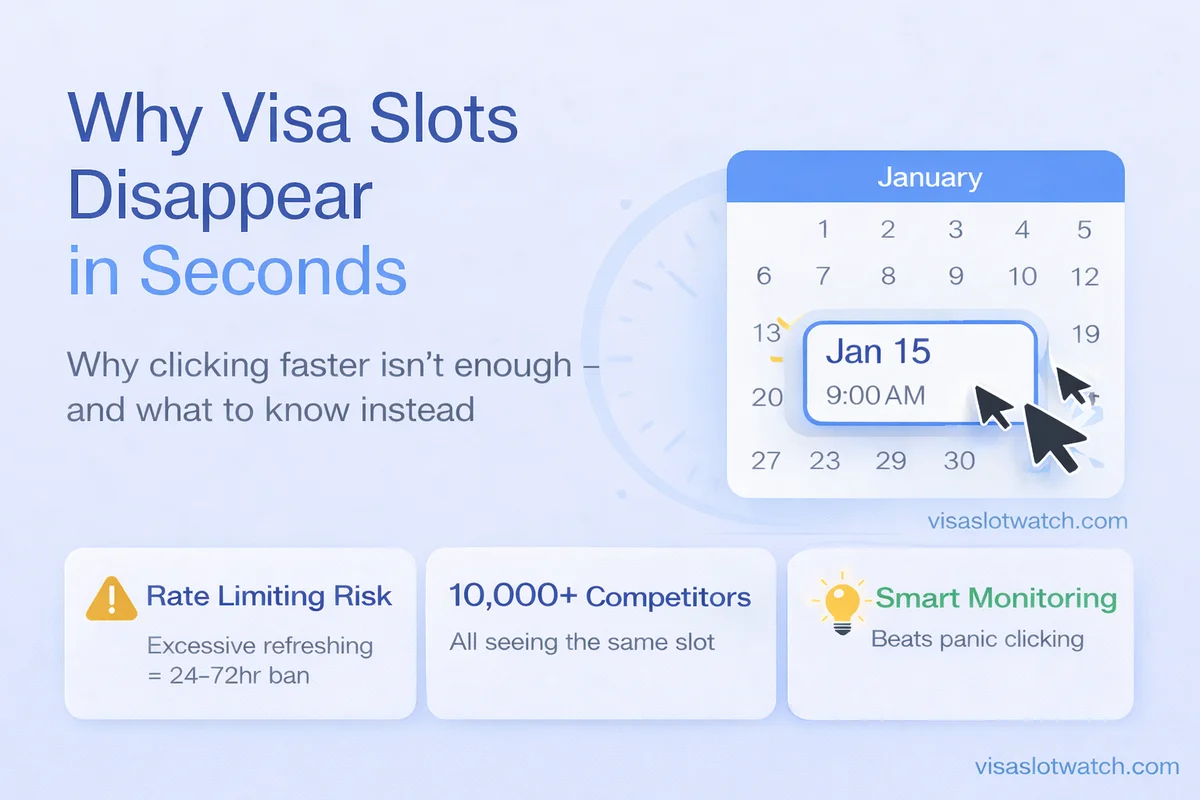
You refresh the visa appointment portal and see it: an earlier date, right there on the calendar. Your heart races. You click to select it. And then — nothing. The slot is gone, as if it was never there.
If this has happened to you, you're far from alone. Thousands of visa applicants experience this frustration daily. The appointment was real. Someone else just got there first.
Understanding why this happens — and why the instinctive response of refreshing more often usually backfires — can save you time, frustration, and possibly a temporary ban from the system.
The Frustration of Vanishing Appointments
New appointment openings, often from cancellations, appear suddenly and can vanish almost instantly. When someone cancels their visa appointment, that slot returns to the pool immediately. At high-demand embassies, it may be gone within seconds.
Consider what happened when 10,000 new student visa slots were released in India at midnight: all 10,000 filled within 5 minutes. That's not a leisurely window — that's thousands of people racing for the same appointments simultaneously.
The result? Many applicants report seeing an available date on the calendar, but by the time they click to book, it's gone. They refresh and find the slot no longer there. It's a frustrating glimpse of a date that no one can actually grab in time.
Visible but Unbookable: The Phantom Slot Problem
Here's the uncomfortable truth: seeing a slot doesn't reserve it for you.
The visa booking system doesn't hold an opening for any one person just because it appears on their screen. When an appointment becomes available, everyone logged in around that time can see the same slot. Until someone successfully completes the booking, it shows as open to all.
Think of it like a single concert ticket on sale. Lots of people might see it's available, but only one person can actually purchase it. If another person claims it seconds before you do, you'll hit a dead end, and the slot will disappear as if it was never real.
This is why you might click on a date that looks perfectly available, fill in your details, hit confirm, and receive: "This appointment is no longer available."
You didn't imagine the slot. It existed. Someone else just finished the booking process faster.
One Slot, Many Eyes: The Competition Problem
When a dozen people happen to be checking at 9:00 AM and one earlier date pops up, all dozen will likely notice that slot. They'll all attempt to book it at once, but only the fastest one succeeds. Everyone else just sees it vanish.
The math at high-demand embassies is brutal:
Hundreds of thousands of people are waiting for appointments
Maybe dozens of cancellations appear per day
Each cancellation is visible to everyone simultaneously
The ratio of people looking to slots available can be 10,000:1 or worse
This isn't a queue where you wait your turn. It's a first-come, first-served race where everyone is running at the same time.
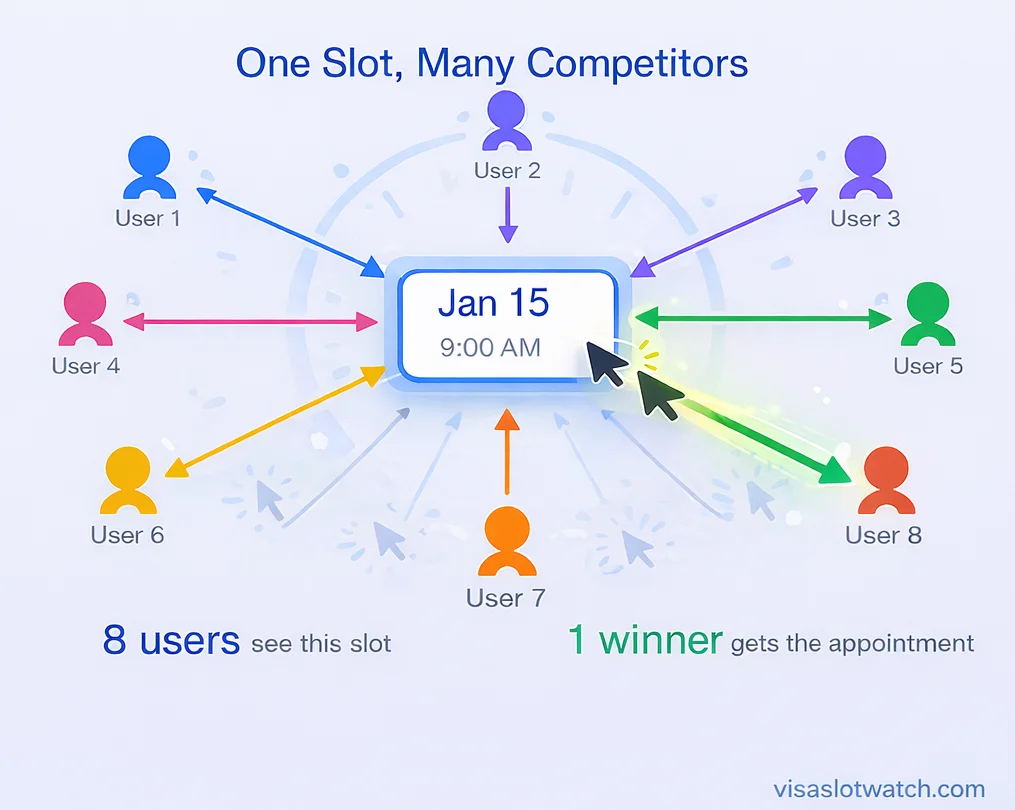
Multiple applicants compete for every available slot
The Refresh Trap: Why Hitting Reload Often Fails
When faced with vanishing slots, the natural instinct is to refresh more frequently. If you just check more often, you'll catch one eventually, right?
Unfortunately, this approach often backfires for two reasons.
Reason 1: Rate Limiting and Temporary Bans
The official visa scheduling system watches for rapid, repeated page loads — the kind of behavior bots might exhibit. Excessive refreshing can trigger rate limits, extra verification steps, or temporary blocks (durations vary by country and account).
Many frustrated users unknowingly trigger these blocks. They refresh the page over and over, only to suddenly get an error like "no available appointments" everywhere or "Exceeded the allowed number of requests." That's the system rate-limiting you for over-checking.
In effect, by refreshing too aggressively, you might miss a slot because you've been temporarily kicked out of the system during the critical window when one appeared.
Reason 2: Human Limits
Even if you avoid getting banned, manual refreshing has practical limits. New slots often appear at random hours — including the middle of the night. No one can be awake and clicking 24/7.
A slot that opens for only a few minutes at 3 AM will slip by while you're sleeping. The one time you step away for a meeting or a meal could be when the perfect appointment appears and disappears.
Why Speed Alone Won't Secure a Slot
Some users have learned the hard way that pure speed can backfire. They set browser auto-refresh plugins to hit the site every few seconds, thinking it gives them an edge. Instead, they ended up banned for 72 hours rather than booking an appointment.
Others managed to click a slot the moment it showed up, only to find it was already gone — meaning someone else was just a hair faster or got lucky.
Being quick is helpful, but it's not the silver bullet. Consider that when thousands of applicants compete for the same handful of slots, many of those people are also being "fast." Yet most still end up empty-handed.
The anti-bot safeguards mean that if you try to be too fast using automated scripts or aggressive refresh rates, you'll just get flagged and blocked.
Getting a visa appointment isn't like a sprint you can win by outrunning everyone else. It's more like trying to catch a falling star — timing matters, but so does being in the right place, and sometimes just plain luck.
What Actually Works: Smart Timing Over Panic Clicking
The better approach is a steady one: stay alert, check regularly but not obsessively, and be prepared to move quickly when a slot appears.
Be Prepared to Act
When you do find an available slot, every second counts. Prepare in advance:
Stay logged in: Keep a session active so you don't waste time on login
Know the booking flow: Memorize the steps so you can move quickly
Have your documents ready: Confirmation number, passport details, payment info — all accessible
Use a stable connection: Don't try to book on slow or unreliable internet
Check at Strategic Times
Instead of refreshing constantly, consider:
Very early morning (4-6 AM embassy local time) — before the crowds wake up
Late night (10 PM - midnight) — when fewer people are checking
Weekday mid-mornings (9-11 AM) — after the initial morning rush
Off-peak days — mid-week often sees less competition than weekends
Consider Monitoring Tools
Automated monitoring tools have become popular because they solve the timing problem without triggering rate limits. These tools:
Check at regular, respectful intervals 24/7
Alert you immediately when slots appear
Don't require you to stay glued to your computer
Use the same data you'd see manually — just more consistently
Think of it as having a tireless assistant who watches for you around the clock and taps you on the shoulder when something interesting appears.
VisaSlotWatch is not affiliated with the U.S. government or the AIS provider.
Staying Calm and Prepared
The visa appointment race can be mentally exhausting. The constant cycle of hope and disappointment — finding a slot only to see it vanish — creates real stress.
Remember: you're competing with thousands of others in the same boat. This isn't personal, and it doesn't mean you're doing something wrong.
Here's what you can control:
Set realistic expectations: Slots do appear, but catching one takes patience and some luck
Use tools rather than constant manual effort: Your mental health matters
Prepare for when the opportunity comes: Have everything ready so you can act fast
Cast a wider net: Consider monitoring multiple embassies if you have travel flexibility
Stay persistent: The people who eventually succeed are the ones who keep trying
Catching a slot is about patience and timing rather than sheer frequency of refreshing. A calm, prepared approach will serve you better than frantic clicking ever could.
Stop refreshing manually and risking account lockouts. VisaSlotWatch monitors your embassy 24/7 with respectful check intervals and sends instant alerts when earlier dates appear. Work smarter, not harder.