
Why US Visa Appointments in Canada Are Booked Out to 2028 — And What You Can Do
Canada’s US visa interview calendar is now pushed far into 2027–2028. Here’s what the data shows, why it’s happening, and realistic strategies to move earlier without risky shortcuts.
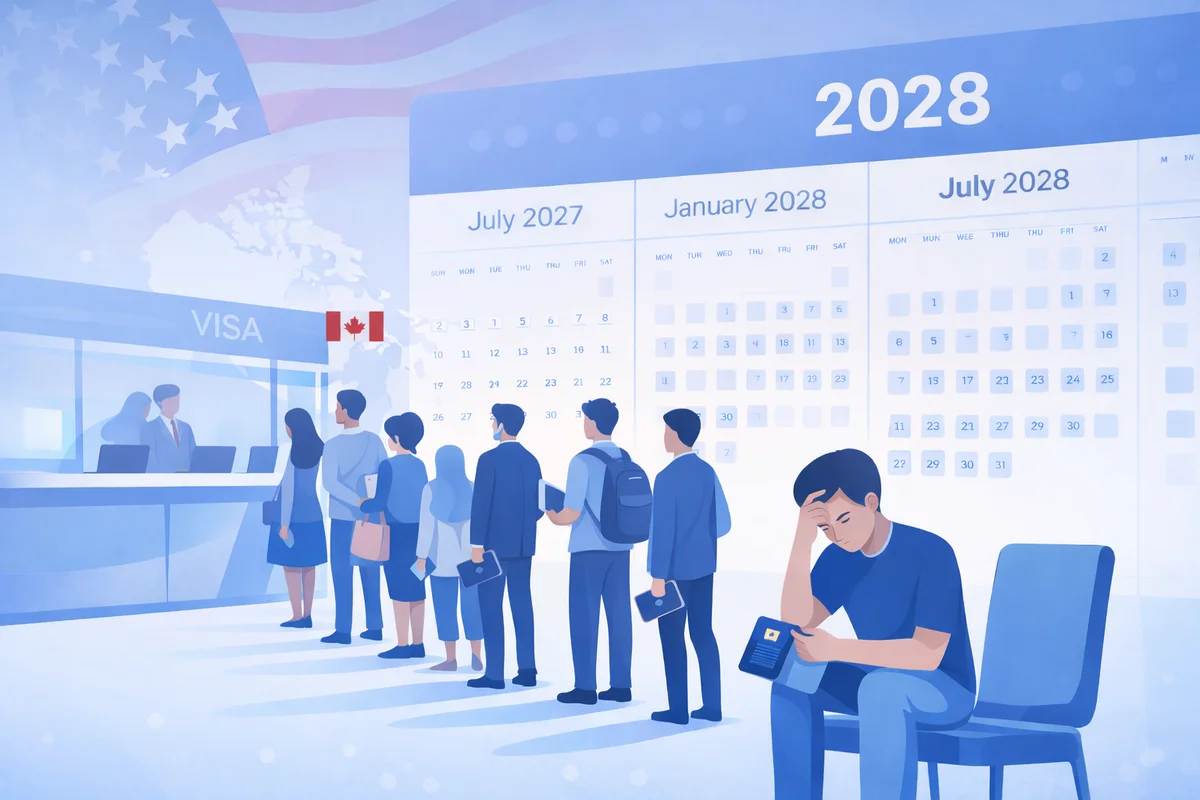
If you’re trying to schedule a US visa interview in Canada right now, the queue can look shocking. Our monitoring and official data indicate that earliest bookable dates now push into 2027—and in the worst cases, early 2028.
This post breaks down what the latest snapshot shows, why the backlog is unusually severe in Canada, and concrete, realistic steps you can take to move earlier without risky, counterproductive shortcuts.
What the data shows in Canada right now
In the US Department of State’s Global Visa Wait Times table (snapshot: late March 2026), some Canadian locations show the following for interview‑required B1/B2 (visitor) appointments:
Calgary: ~22 months to the next available B1/B2 appointment (recent average ~12.5 months)
Toronto: ~17 months next available (recent average ~17 months)
Vancouver: ~13 months next available (recent average ~12.5 months)
Because the table rounds in 30‑day months, a 22‑month reading in late March 2026 effectively pushes first availability into early 2028 for some applicants.
“Next available appointment” and “average wait time” are different metrics; average is not a guarantee and can diverge if people successfully reschedule into newly released earlier slots.
Canada isn’t uniform across locations or categories. Some categories (e.g., students/exchange, petition‑based work) can be measured in months rather than years.
Why demand in Canada is unusually high
Contrary to some headlines, this isn’t mainly about Canadian citizens. Most Canadian citizens don’t require a nonimmigrant visa for typical tourism or short business visits. But Canada has a large base of visa‑required residents:
Permanent residents and many temporary residents in Canada need visas based on nationality.
IRCC reported millions of valid temporary permits in 2024, including hundreds of thousands of study‑permit holders, alongside substantial work‑permit volumes.
Global demand rebounded: the State Department issued ~11M nonimmigrant visas in FY2024, ~6.5M of which were B1/B2.
Canadian consulates process meaningful volumes (e.g., ~98k Toronto, ~75k Vancouver in FY2024), but throughput can still be overwhelmed if the local pool grows faster than interview capacity.
Why supply of interview slots is constrained
Wait times are driven by “workload and staffing” and vary week to week; creating slots requires trained adjudicators, screening, facilities, and support staff.
COVID‑era shutdowns and staggered reopening created a long tail of backlog pressure that still affects high‑volume categories like B1/B2.
Prioritization of students and exchange visitors (tied to academic calendars) can leave B1/B2 absorbing “leftover” capacity at peak times.
Policy shifts that made queues worse
Interview‑waiver narrowing (late 2025): After expanded waivers, eligibility narrowed effective Oct 1, 2025. Most applicants now generally require in‑person interviews, with limited exceptions. More renewals back in line → higher interview demand.
“Apply where you reside” guidance (Dec 2025): Applicants are instructed to schedule in their country of nationality or residence. Scheduling elsewhere may mean significantly longer waits and qualification hurdles; fees are non‑refundable and non‑transferable. This effectively pushes many Canada‑resident foreign nationals to apply in Canada.
Additional operational and vetting changes in 2025 briefly disrupted certain categories, and tighter vetting expectations can slow overall processing.
Practical ways to get an earlier appointment from Canada
Book the earliest slot, then reschedule opportunistically. Embassies add appointments regularly; after scheduling, move earlier when a slot appears. Published wait times are “generally the maximum.”
Use Canada’s multi‑location reality. If eligible, compare cities rather than defaulting to the closest one. In March 2026, next availability varied notably between Vancouver (~13 months) and Calgary (~22 months), with Toronto also long (~17 months).
Check interview‑waiver eligibility early. Key B1/B2 pathway: renewal within 12 months of prior expiration (subject to criteria); generally apply in country of nationality or usual residence. Waived cases aren’t shown in wait‑time tables.
Request expedites only when you truly qualify. Submit DS‑160, pay the fee, and book the earliest slot first. Qualifying reasons: urgent medical needs, funerals, school start dates. Weddings, annual conferences, or last‑minute tourism typically don’t qualify.
Avoid “consulate shopping” without a clear basis. Applying outside nationality/residence can mean longer waits and non‑transferable fees; treat it as a last resort unless rules plainly fit your case.
Plan for total timeline risk. Official wait times don’t include post‑interview administrative processing; timing varies when required.
How VisaSlotWatch fits a realistic strategy
The Department’s own advice implies a dynamic calendar: new slots are added regularly, and applicants seeking earlier dates should “check back regularly” and reschedule when earlier options appear. That’s a stream, not a one‑time decision.
This is the gap VisaSlotWatch addresses. It monitors availability within your authenticated browser session and alerts you when earlier dates appear—so you don’t have to manually refresh all day.
Monitoring + alerts, not booking. You still make changes yourself; the tool reduces the chance you’re simply too late.
Supports AIS and multiple embassies. Depending on plan, monitor more than one Canadian city—aligning with the “multi‑post” strategy.
Respectful cadence and multi‑channel notifications. Tiered intervals (e.g., every 5–120 minutes), alerts via browser, email, Telegram, or Slack.
VisaSlotWatch is not affiliated with the US government or the AIS provider.
Key takeaways
Some Canadian B1/B2 “next available” timelines push into 2027–2028 (e.g., ~22 months Calgary, ~17 months Toronto, ~13 months Vancouver as of late March 2026).
Backlog drivers: large visa‑required resident base in Canada + global demand recovery vs. staffing‑bound interview capacity.
Policy shifts: narrower interview waivers and “apply where you reside” guidance push more people into in‑person queues in Canada.
Best strategy: schedule the earliest slot, then reschedule into newly released openings—new slots are added regularly.
VisaSlotWatch helps by automating monitoring and alerts—boosting your odds of catching a fleeting opening without constant refreshing.
Useful links
Install / Update Extension | View Sample Alerts | Contact Support | Visit VisaSlotWatch