
US Visa Wait Times 2026: Current Appointment Delays by Country
US visa appointment wait times in 2026 range from under 3 weeks to over a year depending on the country and embassy. See current B1/B2 delays by country, why they change, and how to find earlier dates.
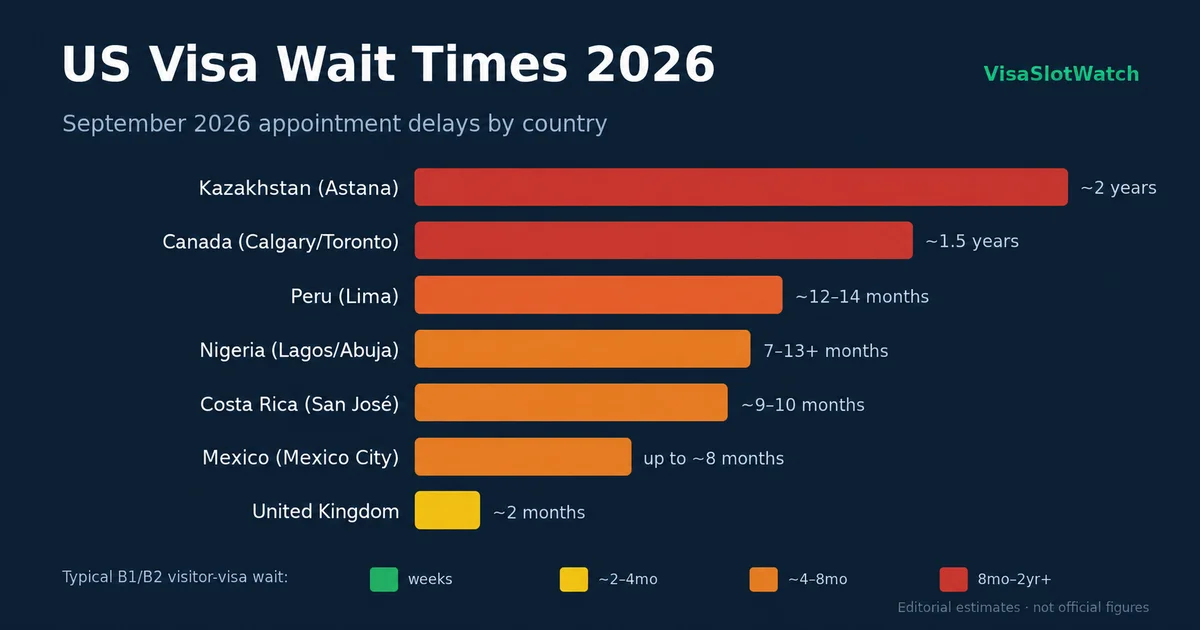
How long is the wait for a US visa appointment in 2026? It depends entirely on where you apply. Right now the same B1/B2 visitor visa can mean a two-to-three week wait in one country and well over a year in another.
This guide gives you current 2026 US visa appointment wait times by country and embassy, explains what drives the huge differences, and shows you how applicants are finding earlier dates.
Disclaimer: Figures below are editorial estimates based on State Department data, embassy notices, and applicant reports. For official wait times, check the U.S. Department of State visa wait time page. Availability changes daily.
Methodology note: Embassy tables refer to B1/B2 visitor visa appointment waits unless otherwise noted. Waits differ sharply by visa type (B1/B2, F-1, J-1, L, O) at the same post — see the section on why below.
US Visa Wait Times by Country — 2026 Quick Reference
Jump to your country: United Kingdom · Canada · Spain · Kazakhstan · Mexico · Colombia · Peru · Costa Rica · Chile · India · China · Turkey · Brazil · Nigeria · Russia
| Country | Typical Wait (2026) | Trend | VisaSlotWatch support |
|---|---|---|---|
| Canada | B1/B2: typically 14+ months; varies by post | Long — high renewal demand from third-country nationals | Supported now |
| Nigeria | B1/B2: 7–13+ months | Longest globally (Lagos, Abuja) | Wait-time information only |
| India | B1/B2: 2–4 months (varies by city) | Much improved from 2022 | Coming soon |
| Mexico | B1/B2: 2–8 months (varies by consulate) | Long in Mexico City, shorter in border posts | Supported now |
| China | B1/B2: 2–6 months | Backlog as travel demand returns | Wait-time information only |
| Brazil | B1/B2: 1–5 months | Recovered strongly | Supported now |
| Turkey | B1/B2: 1–5 months | Ankara/Istanbul variable | Wait-time information only |
| Peru | B1/B2: around 12–14 months (Lima) | Long queue (editorial estimate — below our publication floor) | Wait-time information only |
| Costa Rica | B1/B2: around 9–10 months (San José) | Steady, long queue (editorial estimate — below our publication floor) | Wait-time information only |
| Spain | J-1: around 2 months; L-1: around 3 weeks; F-1: often within days; B1/B2 not published from VisaSlotWatch data | Student/exchange/L-1 demand in Madrid | Supported now |
| Chile | L-1: often within 1–2 weeks (Santiago) | Fast recently (editorial estimate — below our publication floor); B1/B2 not published | Wait-time information only |
| Colombia | B1/B2: highly variable — days to ~8 months (Bogotá) | Swings widely (editorial estimate — below our publication floor); check for openings rather than relying on a single number | Supported now |
| United Kingdom | B1/B2: around 2 months | Well-staffed | Supported now |
| Kazakhstan | B1/B2: often around 2 years | Visitor-visa queues run long; other categories can be much shorter | Supported now |
| Russia | Limited service | Third-country processing (Warsaw, Astana) | Wait-time information only |
Wait time depends heavily on visa type. Most figures above are for B1/B2 visitor visas, the most-searched category. Spain is listed separately because the VisaSlotWatch observations we publish there are for student (F-1), exchange (J-1), and intracompany-transfer (L-1) appointments, not B1/B2. Student, exchange, and work-linked appointments can be scheduled on very different timelines at the same post — see why your visa type changes the answer below.
Below we break these down embassy-by-embassy, and explain why your visa type can matter as much as your country.
What “Wait Time” Actually Means
The official wait time published on State Department sites estimates how long until the next available interview slot. It’s updated daily based on recent scheduling data — but it’s not a guarantee. Think of it as a weather forecast: useful for planning, subject to change.
Key things most sources get wrong:
- It’s not your total processing time. The number only covers the queue for an interview appointment. After the interview, visa stamping takes a few more days to weeks — and administrative processing (if triggered) adds more.
- A long wait doesn’t mean lower approval odds. Queue length is purely logistics. A 300-day wait just means high demand, not stricter standards.
- A sudden drop isn’t a glitch. When an embassy’s wait plummets from 200 days to 50, it usually means they released a batch of new slots or received additional staff.
- Interview waivers can bypass the queue. Many renewals qualify for dropbox/waiver processing, which skips the interview wait entirely.
Why Wait Times Differ So Dramatically
Several factors explain why one embassy shows “7 days” while another shows “300+ days”:
- Local demand: Countries with high US travel volume (India, Nigeria, Mexico, Brazil) have far more applicants than available slots. India alone had wait times exceeding 800 days in mid-2022 before aggressive staffing brought many posts down into ~60–90 day ranges by late 2024.
- Staffing and capacity: Many posts still haven’t fully rebounded from pandemic-era cuts. Some received “surge teams” of temporary officers; others remain short-handed.
- Visa category prioritization: Student and work visas often get priority scheduling. Even when India’s tourist queue was astronomical, student applicants were expedited to meet program start dates.
- Seasonality: Student visa applications flood embassies from May through August. Holiday travel spikes tourist demand in October–November. Off-peak windows (September–October, February–March) often have shorter waits.
Why Your Visa Type Changes the Answer
Here’s what most wait-time guides miss: at the same embassy, your wait can differ enormously depending on your visa category. A single published “wait time” for a post lumps together very different queues.
From monitoring live appointment availability, a few patterns hold consistently:
- Visitor visas (B1/B2) usually face the longest queues. They’re the highest-volume, lowest-priority category, so at busy posts they can stretch to a year or more — while other categories at the same embassy move far faster.
- Students (F-1) and exchange visitors (J-1) are often prioritized around program start dates, so their effective waits are frequently shorter than B1/B2 at the same location.
- Dependent and certain work-linked categories (e.g. L-2, O-1) can be scheduled dramatically sooner — sometimes weeks where a B1/B2 applicant at the same post would wait many months.
The practical takeaway: don’t rely on a single headline number for a country. Check the availability for your visa type at your post — that’s the number that actually affects you.
And a long official wait doesn’t mean you’re stuck. Because slots open constantly through cancellations and new releases, earlier dates appear even at posts where the published wait is a year or more — often the difference between traveling this year and next.
Start monitoring your embassy free →
Embassy-by-Embassy Breakdown
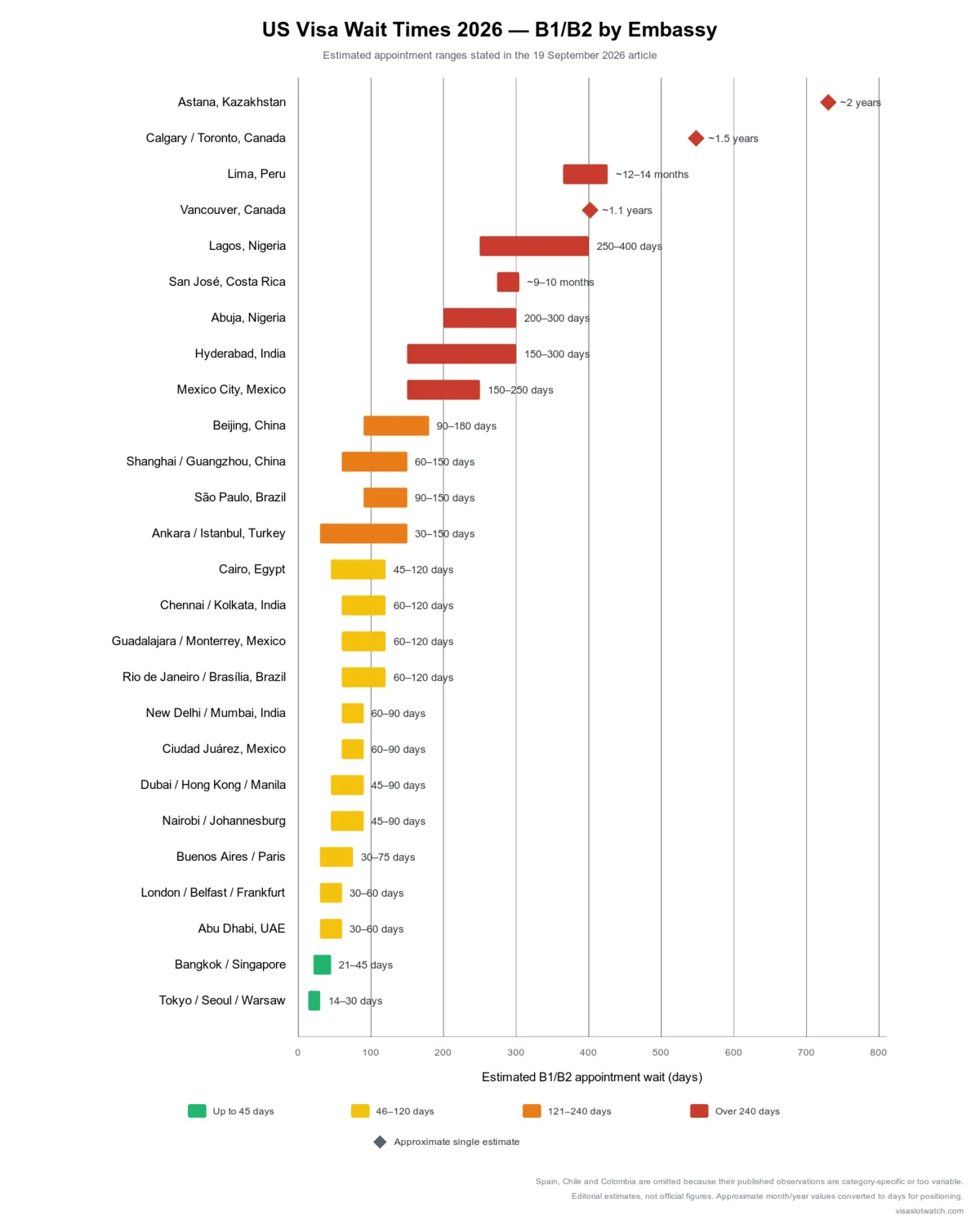
Quick scan (B1/B2, estimated ranges):
- Longest: Astana/Kazakhstan (~2 yrs, B1/B2, from our monitoring), Lagos (250–400), Calgary & Toronto in Canada (~1.5 yrs, from our monitoring), Lima/Peru (~1 yr, editorial estimate), San José/Costa Rica (~9–10 mo, editorial estimate), Abuja (200–300), Hyderabad (150–300)
- Shortest: Tokyo (14–30), Seoul (14–30), Warsaw (14–30), Bangkok (21–45), Singapore (21–45)
India
| Embassy/Consulate | B1/B2 Wait | Notes |
|---|---|---|
| New Delhi | 60–90 days | Dramatically improved from 800+ days in 2022 after 250K extra slots opened |
| Mumbai | 60–90 days | Similar trajectory to New Delhi |
| Hyderabad | 150–300 days | Lagging other Indian posts; fewer officers, huge student demand |
| Chennai | 60–120 days | Check all five Indian consulates — times vary significantly |
| Kolkata | 60–120 days | Often shorter than the southern posts |
Strategy: India’s wait times have improved but still vary widely by city — always compare all five consulates.
China
| Embassy/Consulate | B1/B2 Wait | Notes |
|---|---|---|
| Beijing | 90–180 days | Moderate backlog as Chinese travel demand resurges |
| Shanghai | 60–150 days | Often slightly shorter than Beijing |
| Guangzhou | 60–150 days | Handles high southern-China volume |
Strategy: Compare Beijing, Shanghai, and Guangzhou — availability shifts between them week to week.
Rest of Asia
| Embassy/Consulate | B1/B2 Wait | Notes |
|---|---|---|
| Tokyo, Japan | 14–30 days | Very efficient processing |
| Seoul, South Korea | 14–30 days | Consistently short waits |
| Bangkok, Thailand | 21–45 days | Popular regional alternative |
| Singapore | 21–45 days | Well-managed, shorter waits |
| Hong Kong | 45–90 days | Steady demand |
| Manila, Philippines | 45–90 days | High immigrant-visa volume |
Mexico
| Embassy/Consulate | B1/B2 Wait | Notes |
|---|---|---|
| Mexico City | 150–250 days | High volume from locals and third-country nationals |
| Guadalajara | 60–120 days | Often shorter than Mexico City |
| Monterrey | 60–120 days | Good alternative for northern Mexico |
| Ciudad Juárez | 60–90 days | Handles many employment and immigration cases |
Strategy: Wait times vary sharply between Mexican consulates — compare Mexico City, Guadalajara, Monterrey, and Ciudad Juárez before booking.
Canada
| Embassy/Consulate | B1/B2 Wait | Notes |
|---|---|---|
| Calgary | ~1.5 years | Among the longest Canadian posts in our monitoring |
| Toronto | ~1.5 years | Very high renewal demand, including third-country nationals; now level with Calgary in our monitoring |
| Vancouver | ~1.1 years | Popular, consistently long |
Strategy: Canadian visitor-visa (B1/B2) waits run well over a year across the board, so monitoring for earlier openings pays off most here. Some posts require proof of Canadian residency; check before booking. → See current US visa appointment wait times & alerts for Canada.
United Kingdom
| Embassy/Consulate | B1/B2 Wait | Notes |
|---|---|---|
| London | 30–60 days | Well-staffed, normalized post-pandemic |
| Belfast | 30–60 days | Lower volume alternative |
→ See current US visa appointment wait times & alerts in the UK.
Rest of Europe
| Embassy/Consulate | B1/B2 Wait | Notes |
|---|---|---|
| Frankfurt, Germany | 30–60 days | Multiple German consulates available |
| Paris, France | 30–75 days | Seasonal fluctuations |
| Warsaw, Poland | 14–30 days | Often faster than Western Europe; also serves third-country applicants |
Spain
| Embassy/Consulate | Published VisaSlotWatch Observation | Notes |
|---|---|---|
| Madrid | F-1: often within days | Student appointments moving quickly in our recent monitoring |
| Madrid | J-1: around 2 months | Exchange-visitor queue longer than F-1 at the same post |
| Madrid | L-1: around 3 weeks | Intracompany-transfer category clears our publication standard |
| Madrid | B1/B2: check official/current availability | Insufficient VisaSlotWatch sample for a public B1/B2 country claim |
→ See current US visa appointment wait times & alerts in Spain.
Turkey
| Embassy/Consulate | B1/B2 Wait | Notes |
|---|---|---|
| Ankara | 30–150 days | Variable; the capital post |
| Istanbul | 30–150 days | High volume, fluctuates seasonally |
Russia
Routine US visa services in Russia remain sharply limited. Most Russian applicants are processed at third-country posts such as Warsaw (Poland) and Astana (Kazakhstan), where wait times vary and eligibility rules apply. Always confirm current guidance before traveling to apply.
Kazakhstan
| Embassy/Consulate | B1/B2 Wait | Notes |
|---|---|---|
| Astana (Nur-Sultan) | ~2 years for B1/B2 | Visitor-visa queues run very long; a hub for third-country applicants |
Note: Kazakhstan’s visitor (B1/B2) queues run around two years, but work and dependent categories (e.g. L-2, O-1) are often scheduled much sooner at the same post — always check for your specific visa type. → See current US visa appointment wait times & alerts in Kazakhstan.
Middle East & Africa
| Embassy/Consulate | B1/B2 Wait | Notes |
|---|---|---|
| Abu Dhabi, UAE | 30–60 days | Shorter than Dubai |
| Dubai, UAE | 45–90 days | High demand from expats and regional travelers |
| Cairo, Egypt | 45–120 days | Regional hub |
| Nairobi, Kenya | 45–90 days | East African hub |
| Johannesburg, South Africa | 45–90 days | Regional demand |
Nigeria
| Embassy/Consulate | B1/B2 Wait | Notes |
|---|---|---|
| Lagos | 250–400 days | Chronic backlog; among the longest globally |
| Abuja | 200–300 days | Slightly better than Lagos, still very long |
Strategy: Nigeria remains one of the most challenging locations globally. Some applicants explore neighboring posts — but check third-country national eligibility first.
Brazil
| Embassy/Consulate | B1/B2 Wait | Notes |
|---|---|---|
| São Paulo | 90–150 days | Recovered significantly from pandemic peaks |
| Rio de Janeiro | 60–120 days | Often shorter than São Paulo |
| Brasília | 60–120 days | Capital post |
Rest of South America
| Embassy/Consulate | Observed wait | Notes |
|---|---|---|
| Bogotá, Colombia | B1/B2 highly variable (days to ~8 months) | Swings widely; editorial estimate (below our floor) — see Colombia below |
| Lima, Peru | B1/B2 ~12–14 months | Long visitor-visa queue; editorial estimate (below our floor) — see Peru below |
| Santiago, Chile | L-1 within ~1–2 weeks | L-1 (not B1/B2); editorial estimate (below our floor) — see Chile below |
| Buenos Aires, Argentina | B1/B2 30–75 days | Relatively manageable (editorial estimate) |
Colombia
Bogotá is Colombia’s primary US visa post, and it’s one of the most variable posts we track. Recent checks swung between B1/B2 dates roughly 8 months out and openings just days away — sometimes within the same window. (Our Colombia sample is below our distinct-user publication floor, so treat this as an editorial estimate rather than a published first-party figure.) That volatility is exactly why monitoring beats guessing here: a single headline number would miss the short windows when earlier dates appear. → See US visa appointment wait times & alerts in Colombia.
Peru
| Embassy/Consulate | B1/B2 Wait | Notes |
|---|---|---|
| Lima | ~12–14 months | Long visitor-visa queue; the primary US visa post in Peru |
Editorial estimate — our Peru sample is below our distinct-user publication floor.
Strategy: Peru’s visitor-visa queue runs long, so earlier openings from cancellations are worth watching for.
Costa Rica
| Embassy/Consulate | B1/B2 Wait | Notes |
|---|---|---|
| San José | ~9–10 months | Steady, long visitor-visa queue |
Editorial estimate — our Costa Rica sample is below our distinct-user publication floor.
Chile
At Santiago, the appointments in our recent sample are L-1 (intracompany transfer) — not B1/B2 — and those have been available within about 1–2 weeks. (This is an editorial estimate: our Chile sample is below our distinct-user publication floor.) B1/B2 visitor waits at Santiago are not published from VisaSlotWatch data; check official/current availability for that category.
How Appointment Slots Actually Work
Understanding the mechanics helps explain why wait times change:
- Bulk releases: When embassies get extra resources, they dump large batches of new appointment slots into earlier dates. India’s 250K-slot release cut wait times from months to weeks overnight. These drops are real, not glitches. Act fast when you see one.
- Rolling releases: Many embassies add a few weeks of new slots on a regular schedule. Watch for patterns at your specific post.
- Cancellations and new releases: When someone cancels or a post releases new inventory, earlier dates can return to the pool. This is why monitoring can find earlier dates even when the official wait says 300+ days.
- Interview waivers: If you qualify for dropbox/waiver processing (common for renewals), you skip the interview queue entirely.
Want alerts when appointments open at your embassy? VisaSlotWatch checks your selected AIS locations through your active browser session and notifies you when earlier dates become available.
Should You Switch Embassies or Wait?
A common dilemma. Consider:
- Within your country: If your country has multiple consulates, always compare them. A Mumbai-to-Kolkata switch, or Toronto-to-Calgary in Canada, could save months.
- Third-country options: Applying in another country is possible but risky. Not all embassies accept third-country nationals, and you may face questions about why you’re applying there. Always check the embassy’s website first.
- Cost vs. time: If switching saves 6+ months, the travel cost may be justified. If it only saves a few weeks, waiting (while monitoring for cancellations) is usually simpler.
- Stay within the rules: Don’t double-book appointments at multiple posts. Cancel any you won’t use.
- Avoid credential sharing: Never share your login with agents or third parties; it can violate portal rules and put your account at risk.
The Bottom Line
Your visa wait time depends heavily on where and when you apply. The good news: most embassies have dramatically improved from the worst pandemic-era backlogs, and earlier dates open up daily through cancellations and new releases. The key is being strategic.
Actionable takeaways:
- Check your country’s current wait above, then compare every consulate available to you — even within the same country.
- Apply during off-peak windows (September–October, February–March) when possible.
- Monitor for cancellations — official wait times don’t reflect daily slot churn.
- Use interview waivers if you qualify; they bypass the queue entirely.
- Act fast when wait times drop suddenly — it means new slots were released.
Want alerts when appointments open at your embassy? VisaSlotWatch checks selected AIS locations through your active browser session and notifies you when earlier dates become available — free to start.